June 2026
Assurance for California’s SB 253: Climate Corporate Data Accountability Act
SB 253 shifts the expectations for climate disclosures for big companies operating in California. Assurance will be required from 2027 for Scopes 1 and 2, and from 2030 for Scope 3. Prepare now for compliance; experts warn the surge in demand will put pressure on the assurance market and credible verification pathways cannot be built overnight.
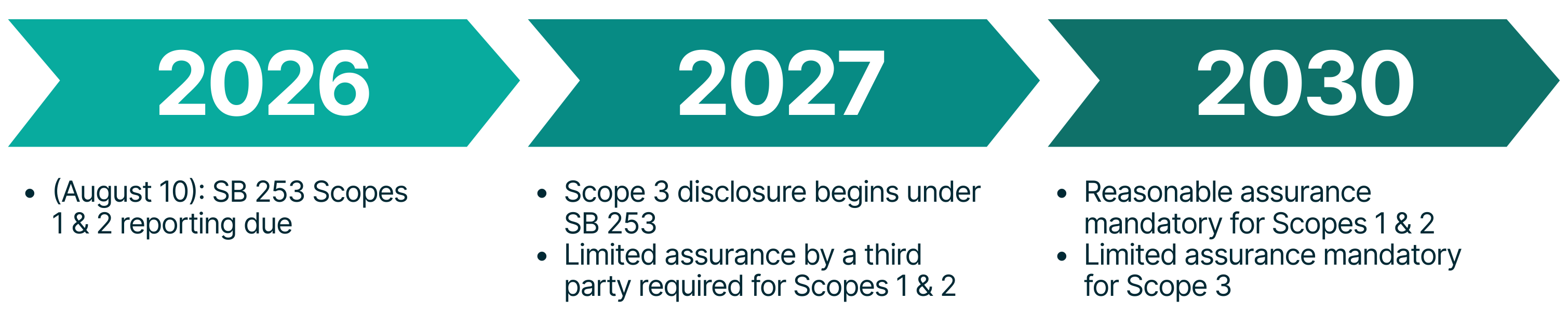
SB 253 (“Climate Corporate Data Accountability Act”) brings a major shift in corporate climate reporting, making GHG emissions disclosure mandatory for all large companies operating in California. SB 253 requires Scope 1 and Scope 2 disclosures in 2026, with the first reports due by August 10, 2026. Scope 3 disclosures are required from 2027. These disclosures must soon be verified by independent third parties, pushing emissions data management from voluntary efforts to legally accountable requirements on par with financial reporting.
For businesses operating in California, the time to prepare for compliance is now. With the transition to mandatory reporting under SB 253, it is crucial to build robust internal data infrastructure to ensure compliance and transparency in good faith efforts.
What is the SB 253 - Climate Corporate Data Accountability Act?
SB 253 requires GHG emissions disclosure, consistent with the requirements of the GHG Protocol. It applies to all corporations and other business entities with annual revenue over $1 billion that do business in California. SB 253 aims to increase corporate transparency and accountability, increasing private decarbonization efforts toward net zero.
Starting in 2026, the affected companies must annually report their GHG emissions, including both direct (Scope 1) and indirect emissions (Scopes 2 and 3). Reports must be made publicly available, inviting a new level of public scrutiny and demanding companies to provide clear and reliable reporting, supported by third-party assurance.
SB 253 was passed alongside SB 261: Climate-Related Financial Risk Act, forming part of California’s broader effort to enhance corporate climate transparency and accountability. The California Air Resources Board (CARB) is responsible for overseeing compliance with SB 253 and developing implementation rules, assurance standards, and enforcement mechanisms.
2026: Grace period for first reporting cycle
Companies that fail to comply with SB 253 may face administrative penalties for failures such as non-filing, late filing, or misstatements. The first reporting cycle (2026) carries a grace period in which penalties will not be imposed, provided that a good faith effort has been made to report accurately.
To demonstrate good faith efforts, companies need:
- Data retention: Maintain raw emissions data and the underlying assumptions used for your calculations.
- Transparency over limitations: Disclose data gaps rather than omit information.
- Progressive improvement: Create a plan with a clear path toward full compliance in 2027.
What do you need to verify?
Independent assurance provides the credibility layer for corporate GHG disclosures, verifying the accuracy and completeness of emissions disclosures.
SB 253 introduces a phased implementation to allow companies time to adapt to more stringent requirements. Limited assurance is optional in 2026 and mandatory starting in 2027 for Scopes 1 and 2. From 2030, reasonable assurance will become mandatory for Scopes 1 and 2 and limited assurance for Scope 3.
Limited assurance offers moderate confidence in data accuracy.
Reasonable assurance provides a high level of confidence, requiring more robust documentation, controls, and auditor involvement.
While assurance is voluntary in 2026, it’s essential to begin the selection process early due to a shortage of qualified verifiers. Furthermore, early starters have a unique opportunity to stress test their GHG calculation approach and provide a gap assessment ahead of mandatory assurance in 2027. The data trail needed for mandatory assurance cannot be built overnight.
What is the role of third-party assurance?
Third-party assurance is key because it:
- Ensures data accuracy
- Maintains compliance with relevant standards, such as the GHG Protocol
- Builds regulatory and investor trust
- Reduces legal risk tied to false or misleading climate claims
- Drives better internal decisions based on accurate data
SustainCERT provides GHG inventory verification, supporting companies in meeting the assurance requirements under SB 253.
GHG inventory verification includes an assessment of:
- Organizational and reporting boundaries (Scope 1, Scope 2, and relevant Scope 3)
- Applied methodologies, assumptions, and calculations
- Underlying data, controls, and supporting evidence
- Whether the inventory is traceable, consistent, and free from material misstatement.
Key dates for SB 253
Verify your GHG inventory
Get in touch to learn how we can support your organization to meet your obligations under SB 253.