• Carbon Credit Verification
  • Resources
LoginContact us
Login
Contact us

Services

  • Carbon verification
  • Value chains

About

  • About us
  • Careers
  • Contact

Resources

  • News
  • Publications
  • Press
  • Privacy Policy
  • Whistleblower Policy
  • Use of Mark Policy
  • Website Terms of Use
  • Allocation of Responsibility
  • SustainCert Terms and Conditions
  • Impartiality Statement
  • Complaints and Appeals
  • Cookie Policy

Sign up to our newsletter

Follow us

© 2025 SustainCERT. All Rights Reserved.
Aerial view
Back to publications

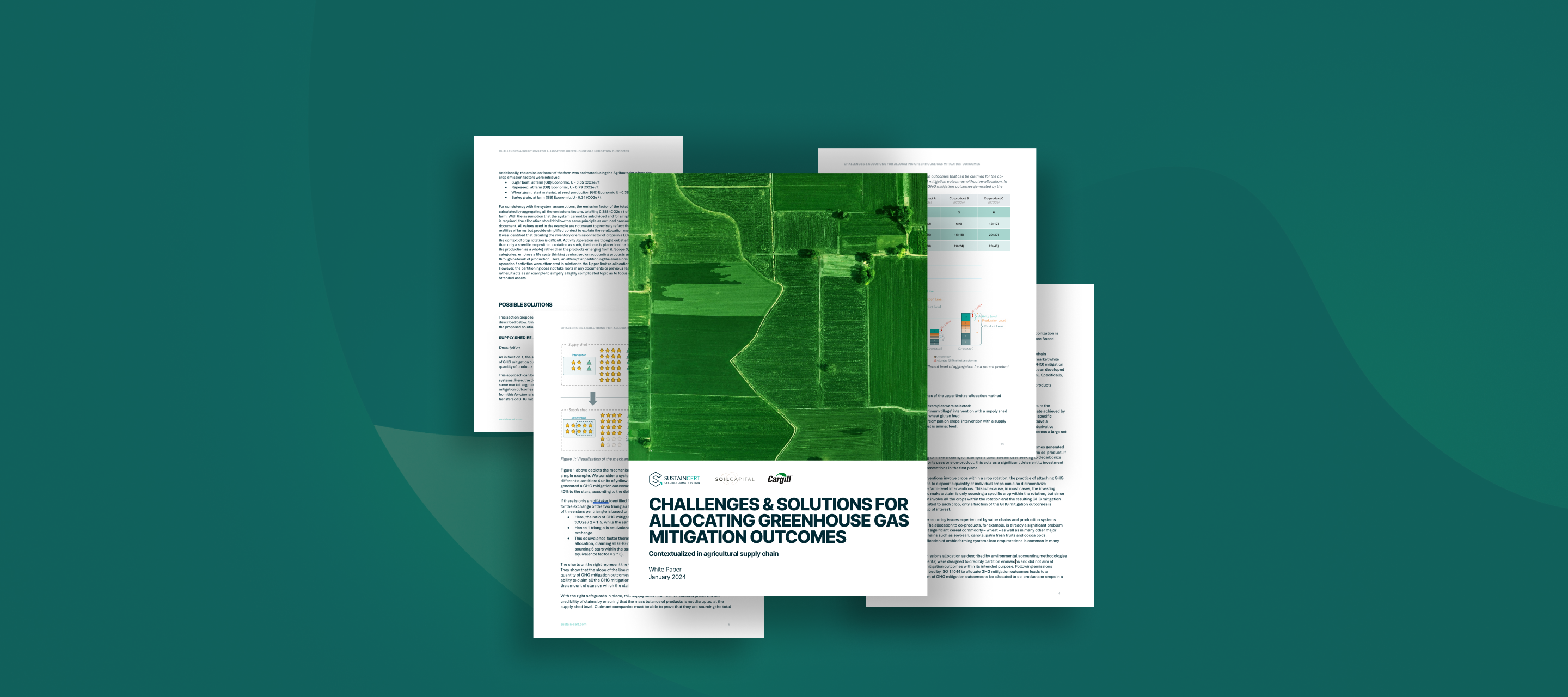
Allocation Greenhouse Gas Mitigation Outcomes

A white paper from SustainCERT, Cargill, and Soil Capital on addressing allocation challenges in agricultural supply chains for credible Scope 3 GHG accounting.

Why download this publication?

As companies accelerate action on Scope 3 emissions, a critical technical barrier is the allocation of greenhouse gas mitigation outcomes when supply sheds generate multiple crops, co-products, or rotational practices. Without clear solutions, mitigation claims risk inconsistency, inaccuracy, or double counting.

This white paper provides technically rigorous yet practical guidance to help organizations:

  • Understand the challenges of allocating mitigation outcomes in multi-crop, co-product, and crop rotation systems.
  • Explore potential solutions that balance fairness, feasibility, and environmental integrity.
  • Learn how different allocation approaches align with existing frameworks such as the GHG Protocol and SBTi guidance.
  • Review case examples illustrating allocation in practice and the trade-offs between methodological rigor and scalability.
  • Identify areas where further collaboration and guidance are needed to strengthen credible Scope 3 claims.
Download your copy

Gain practical insights into one of the most pressing technical challenges in agricultural decarbonization, and discover pathways toward more consistent and credible Scope 3 reporting.


Access this document

Fields marked with * are mandatory.

Our other reading suggestions
Report cover showing a combine harvester in a wheat field with the title on decarbonizing food and agriculture.

Financing Decarbonization in Food and Agriculture Value Chains

This report explores climate finance, innovative funding, and collaborative strategies to scale action. Learn how businesses can leverage co-investment, market-based solutions, and value chain partnerships for real impact. Decarbonization is a business imperative—download the report to lead the transition.
Read more
Cover of the "Scope 3 Research Report" with SustainCERT logo and a green abstract pattern on the right side.

Scope 3 Research Report

A publication from SustainCERT presenting findings from a 2023 study of 500 large organizations in the US and Europe on Scope 3 emissions reporting, interventions, and verification.
Read more
Cover page of a white paper titled

Designing a Balanced Decarbonization Strategy

This white paper from SustainCERT and General Mills explores practical pathways to reduce agricultural Scope 3 emissions by combining claimable value chain interventions with landscape-level investments. Drawing on real-world pilots and the latest GHG accounting guidance, it highlights opportunities, challenges, and solutions for building a balanced approach to net zero.

Read more
Cover of the 'Dual Factor Credibility Framework' report with abstract blue wave design.

Dual Factor Credibility Framework

How can companies ensure their Scope 3 emission reductions are both real and credibly reported? SustainCERT’s Dual Factor Credibility Framework introduces a new approach that combines independent verification of mitigation outcomes with safeguards for co-claiming and reporting. The framework helps companies decarbonize their value chains, avoid double counting, and unlock opportunities for collaboration and co-investment.

Read more
Cover of a report titled "Principles'  by SustainCERT and Climate Ledger,

Principles for Best-Practice Digital Verification

How can digital innovation transform the credibility of carbon markets? This white paper from SustainCERT and the Climate Ledger Initiative explores guiding principles and practical blueprints for digital verification, highlighting how technology can improve accuracy, reduce costs, and scale trusted climate impact.

Read more
photo of tall trees viewed from below.

Digital Measurement, Reporting, and Verification

How can digital innovation make carbon markets more credible and scalable? SustainCERT’s Digital MRV Report explores the state of play in digital Monitoring, Reporting, and Verification, highlighting how new tools can cut costs, improve accuracy, and unlock trust in climate action.

Read more